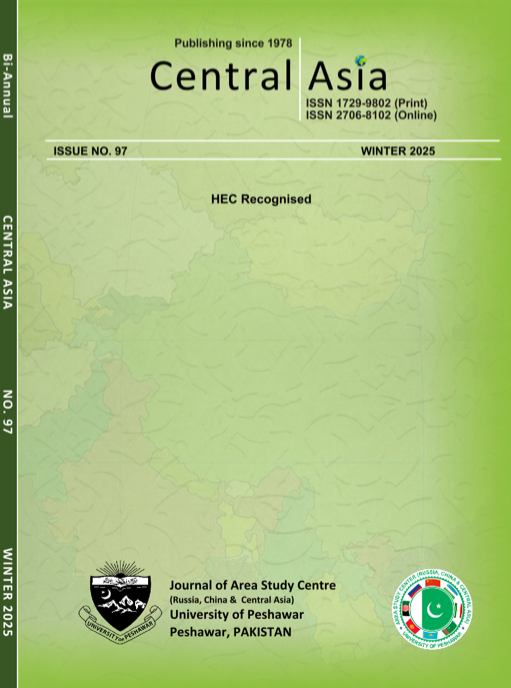
Rational Choices and Selective Cooperation: A Rational Actor Model Analysis of Pakistan-Russia Relations
DOI:
https://doi.org/10.54418/ca-97.259Keywords:
Pakistan-Russia relationship, defence ties, economy, Pakistan-India partnership, utility maximization, rational actor modelAbstract
Despite repeated attempts to upgrade bilateral relationships over more than three decades, Russia and Pakistan have not been able to achieve milestones except for breaking a thaw in their ties. Russia is believed to have a clear tilt towards India and to avoid taking steps that can annoy New Delhi while engaging with Pakistan. However, its tilt towards India and the lack of formidable relations with Pakistan, based on strong foundations in defence and the economy, can better be understood in terms of the utility maximization of these countries for each other. When Russia and Pakistan see their utility for accomplishing national interests, they become natural partners. This trend sees selective cooperation between Pakistan and Russia, even when one takes the Indian factor as a constant. At the same time, both countries tend to balance their desires with compulsions in their foreign policies vis-à-vis the US, China, and India. Furthermore, Russia's traditional defence and economic ties with India are the main hindrance to the upgradation of relations between the two countries. However, these factors in the context of India are better understood when they are explained through the principle of utility maximization. Nonetheless, this article has applied the rational actor model of foreign policy to understand the relationship equation between Russia, Pakistan, and India. This article finds that Russia and Pakistan have advanced their bilateral relations when their interests converge, and both see each other’s utility maximization through cooperation. Hence, India, as a restraining factor in the Pakistan-Russia relationship, is better understood through the lens of the rational actor model, guided by the utility-maximization principle.
References
Ahmed, Adeel, and Zeeshan Memon. "Pakistan and Russia: Economic and Trade Relations." The Asian Bulletin of Green Management and Circular Economy 4, no. 2 (2024): 4-2.
Ali, Usman, and Tauseef Javed. "Pakistan-Russia Emerging Cooperation: Opportunities and Challenges." Margalla Papers 28, no. 1 (2024): 141-160. https://cssplatformbytha.com/wp-content/uploads/2024/11/PAKISTAN-RUSSIA-EMERGING-COOPERTION-OPPORTUNITIES-AND-CHALLENGES.pdf
Chia, Claudia, and Zheng Haiqi. "Russia-Pakistan economic relations: Energy partnership and the China factor." Journal of Eurasian Studies 4, no. 4 (2021): 20-36. https://www.isas.nus.edu.sg/papers/russia-pakistan-economic-relations-energy-partnership-and-the-china-factor/
Chughtai, Alia ‘What are India and Pakistan military capabilities’, 2025. Aljazeera.https://www.aljazeera.com/news/2025/5/8/what-are-india-and-pakistans-military-and-nuclear-capabilities
Han, Xiaochuang, Eunsol Choi, and Chenhao Tan. "No permanent friends or enemies: Tracking relationships between nations from news." arXiv preprint arXiv:1904.08950 (2019).
Khan, Hafeez Ullah. "Pakistan-Russia relations and the changing paradigm." J. Pol. Stud. 26 (2019): 231.
Khan, Muhammad. "The Evolving Nature of Pakistan-Russia Strategic Relationship." Strategic Thought 7, no. 1 (2025): 19-34. https://strategicthought.ndu.edu.pk/index.php/site/article/view/116/96
Khan, Muhammad Taimur Fahad. "Pakistan’s Foreign Policy towards Russia." Strategic Studies 39, no. 3 (2019): 89-104. https://issi.org.pk/wp-content/uploads/2019/11/6-SS_Muhammad_Taimur_Fahad_Khan_No-3_2019.pdf
Klyszcz, Ivan U. "Russia and the Taliban takeover." research paper, Foundation pour la Recherche Strategique 17 (2021): 2021. https://www.frstrategie.org/sites/default/files/documents/publications/recherches-et-documents/2021/172021-02.pdf
Murad, Muhammad, Muhammad Ramzan Kolachi, and Uroosa Ishfaq. "Nuclear Suppliers Group (NSG) membership: The case of India and Pakistan." Global Political Review 3, no. 2 (2018): 31-39.
Naeem, Shabana, and Shabnam Kausar. "Kashmir Issue During Musharraf Era: A Diplomatic Shift Towards Peace." Social Science Review Archives 3, no. 2 (2025): 383-394. https://policyjournalofms.com/index.php/6/article/view/624/653
Qazi, Afsah, Muhammad Shoaib, and Muhammad Faisal. "Russia–Ukraine War and the indo-pacific: A perspective from Pakistan." Journal of Asian and African Studies 60, no. 1 (2025): 617-634. Russia-Ukraine war_Pakistan perspective .pdf
Ullah, Najeeb, and Muhammad Abbas Brohi. "International north-south transport corridor: Challenges and opportunities for Pakistan." Stratagem 1, no. 1 (2018): 100-113.
Xinhua News Agency. “Pakistani Jets Destroy Air Defense System in India’s Punjab.” May 10, 2025. Edited by Huaxia. https://english.news.cn/20250510/8db95ed002b84d229272289fca5b789b/c.htm
Downloads
Published
How to Cite
Issue
Section
License

This work is licensed under a Creative Commons Attribution-NonCommercial-ShareAlike 4.0 International License.